
Infrastructure bonds, which were relied upon the most in 2024-25 (FY25) by commercial banks to raise funds through the domestic debt capital market amid lagging deposit growth, seem to have lost their sheen in FY26. So far in FY26, no bank has tapped the domestic debt capital market to raise funds via infra bonds, and the expectation is that the amount raised through this route will be significantly lower than that last year, unless credit demand picks up.

'India is a big market for StanC, and it is also fastest growing economy in the world.'

The Jane Street-Sebi saga is more than a legal dispute -- it's a litmus test for India's ambitions as a global financial hub.

In Q1FY26, the bank reported fresh slippages of 8,200 crore, up 71 per cent Y-o-Y and sequentially. Of this, 7,500 crore is from the retail segment.
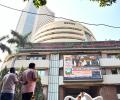
'BSE has facilitated nearly Rs 35 trillion in capital raising across multiple segments.'
Sebi aims to stay proactive as HFT and quant firms like Citadel Securities, Optiver, Millennium, and IMC Trading are expanding rapidly in India, which is home to the world's largest derivatives market by contracts traded.

Promoters of India's top private listed companies have cut their stakes sharply since 2021, taking advantage of elevated valuations and reshaping ownership dynamics in the market. Holdings of promoters in the top 200 privately owned listed firms declined nearly 600 basis points (bps) to 37 per cent at the end of FY25, from 43 per cent in FY21.

State-owned banks have received guidance from the government to close Jan Dhan accounts whose beneficiaries are unwilling to keep them active, amid rising instances of such accounts being misused by fraudsters as mule accounts to defraud people, people aware of the development said.

There is a need for real-time or near real-time credit reporting, instead of the current fortnightly system, to improve underwriting precision, enable timely reflection of borrower actions such as loan closures or repayments, and deliver a superior consumer experience, Deputy Governor of the Reserve Bank of India (RBI), M Rajeshwar Rao said on Wednesday.

'$125 million for the hull and the remaining of over $350 million for liability.'

The claims will include three kinds of liabilities: Damage to the aircraft; loss of lives who were aboard the aircraft; including the crew members; and third-party liability because of loss of lives where the aircraft crashed; and cargo liability.

'The retail industry is still growing in double digits.'

'The brand, the team, and the people have to make the transition from playing league matches to Test matches.'
The change in stance to neutral from accommodative in the June monetary policy meeting does not necessarily signal that the Reserve Bank of India's (RBI's) rate setting body - monetary policy committee (MPC) - will go on a prolonged pause on rate cuts going forward, believe experts.

HDFC Bank on Sunday said that it will "pursue all lawful remedies" to recover public funds and address the retaliatory actions taken by the Mehta family of the Lilavati Kirtilal Mehta Medical (LKMM) Trust, which has filed a complaint against the bank's managing director (MD) & chief executive officer (CEO) Sashidhar Jagdishan alleging financial fraud.

Foreign investment in bonds issued by Indian corporates touched a 10-year high in May at 20,996 crore, driven by $3.35 billion fundraise by the Shapoorji Pallonji (SP) group, which saw infusion from Deutsche Bank, BlackRock, Morgan Stanley, Davidson Kempner, and Cerberus Capital, among others. The SP group sold three-year bonds, offering 19.75 per cent yield compounded annually and payable at maturity.

State-owned Life Insurance Corporation (LIC) on Thursday entirely subscribed to the Rs 5,000 crore bond issue of Adani Ports and Special Economic Zone (APSEZ) at a coupon rate of 7.75 per cent, said sources privy to the development.

'Now we have one of the best asset qualities in the industry.'

The interplay between domestic and foreign capital will shape India's equity markets.

Domestic institutional investors (DIIs), mostly mutual funds and insurance companies, overtook foreign portfolio investors (FPIs) in ownership of NSE-listed companies in the March quarter of 2025. According to Prime Database, DIIs held a 17.62 per cent stake, up from 16.89 per cent in the December 2024 quarter.
 © 2026 Rediff.com - Advertise with us - Disclaimer - Privacy Policy - Sitemap - Feedback - About us - Terms of use - Grievances